Compare
Luxury Sauna vs Prefab
Four categories, four different products. Here is what actually separates them, including where the cheaper answer is the right one.
Read this first
We are not the right answer for everyone.
A comparison page written by one of the options is worth exactly as much as its willingness to argue against itself. So: if you want a sauna for occasional use, at the lowest entry price, in a space you may not live in for long, a quality kit is a sensible purchase. Buy the kit.
What follows is about what changes as you move up, and who each step is actually for.
The four categories
What each one actually is.
Barrel kits and flat-pack imports, roughly $5,000 to $10,000. A shape and a heat source, shipped as parts for you or a contractor to assemble. Standard softwood, a small heater, minimal insulation. Gets hot. Rewards low expectations and light use.
Direct-to-consumer cabins, roughly $9,000 to $15,000. Better fit and finish, real branding, often infrared or an entry traditional heater. Assembled panels rather than an engineered structure. This is where most people start looking, and for many it is enough.
Premium production cabins, roughly $15,000 to $28,000. Improved materials, better heaters, more considered detailing. Still fundamentally a manufactured cabin placed in your yard rather than a building designed for it.
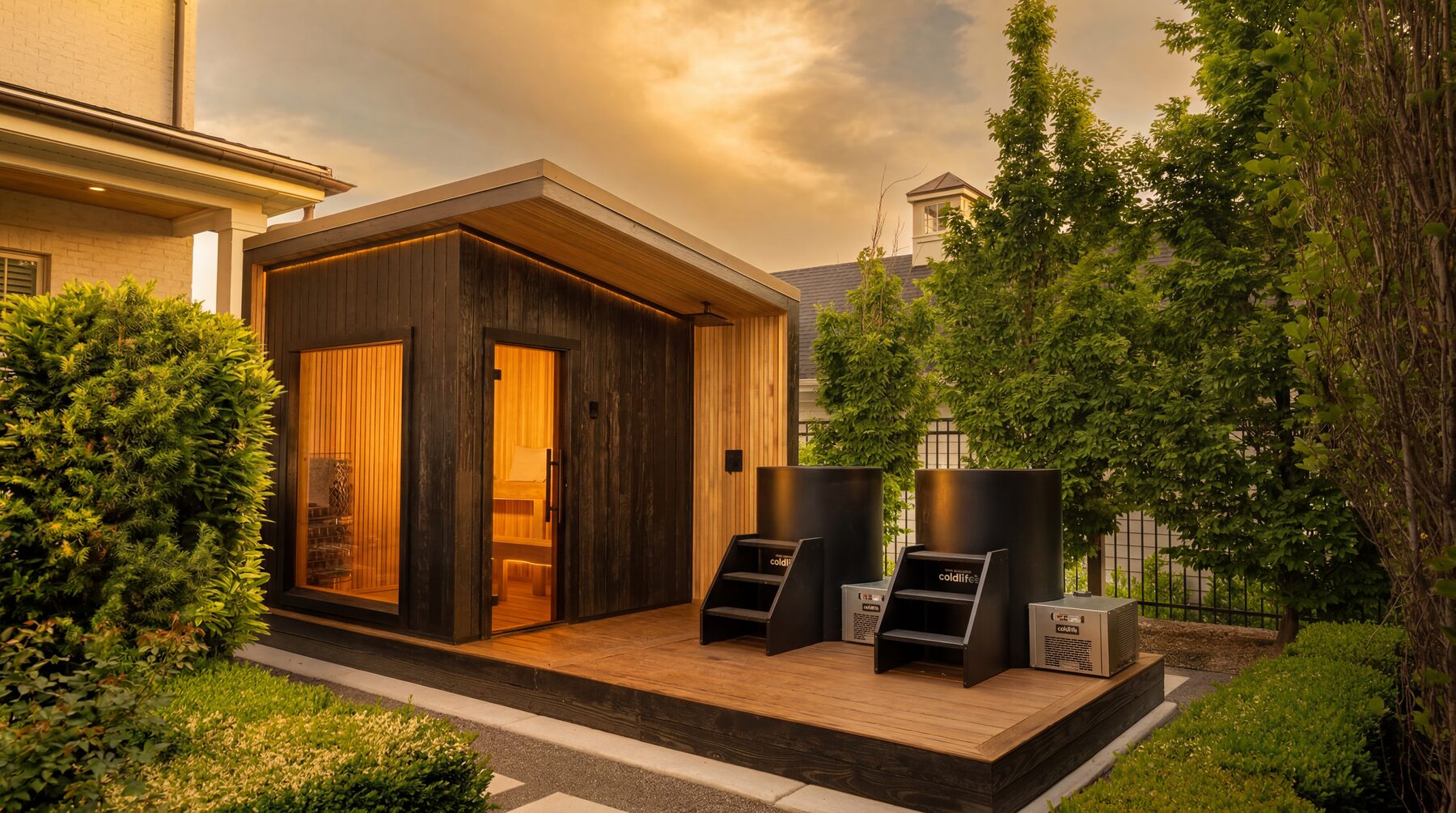
Hand-built engineered suites, from $25,700. Stamped plans, thermally modified sauna-grade materials, a multi-layer wall, a commercial heater with real stone mass, and on the suites a cold plunge integrated into the same envelope. Delivered ready to run. This is what we build.
The real differences
What changes as you move up.
How long it lasts outdoors. This is the big one. Standard wood in a climate with real freeze and thaw moves, cracks and greys. Thermally modified wood is cooked to remove moisture and sap so it holds its shape through decades of heat cycles.
What the heat feels like. Stone mass, not wattage, determines whether the room produces soft löyly or dry harsh air that goes flat the moment you add water. The heater guide covers this properly.
Whether cold is part of it. A plunge across the yard gets used in July and ignored in February. A plunge a few steps from the sauna door gets used all year. Integration is a design decision, not an accessory.
Who does the work. A pallet of parts and a delivered, placed, connected, tested building are different products regardless of what the photos suggest.
Choosing
How to pick honestly.
Ask how often you will genuinely use it. Occasional use rewards a low entry price. Daily use over years rewards construction, because the difference compounds every winter.
Ask whether you want cold in the loop. If yes, integration is worth more than any other single upgrade. Ask how long you will be in the house. And ask what replacing it in five years would cost, because in this category the sticker price and the total cost of ownership tell different stories.
The quiz takes about three minutes and will point at a model, or at none of ours.
FAQ
Comparison questions.
Is a prefab sauna worth it?
For occasional use at a low entry price, yes. Prefab and kit saunas do the basic job. The trade is materials, structure, heat quality and lifespan, which matter most if you plan to use it daily for years.
What is the difference between a luxury sauna and a prefab one?
Engineered structure with stamped plans rather than assembled panels, thermally modified sauna-grade wood rather than standard softwood, a commercial heater with real stone mass, and on suites an integrated cold plunge. Plus delivery and installation as a service rather than a pallet of parts.
Is infrared or traditional better?
They are different appliances. Infrared warms the body directly at a lower air temperature and cannot take water, so there is no steam. Traditional produces the steam and heat this practice is built around.
Do I need the cold plunge?
Not to have a good sauna. But if you want contrast in your routine, integrating the plunge into the same envelope is what makes it happen year-round rather than in summer only.
How much should I spend?
As much as the use justifies and no more. Occasional use, buy a kit. Daily use over a decade, buy construction. The cost guide breaks the ranges down in detail.
Keep exploring.
Take the product quiz
Three minutes to find the right sauna and cold plunge for your space.
Browse the lineup
Hand-built saunas and cold-plunge suites across three tiers. From $26k.
The Craft
Engineered plans, sauna-grade materials, and how we build to last.
Owner stories
Real saunas and cold plunges installed in real backyards.
FAQs
Timeline, cost, permits, delivery, warranty. Straight answers.
Request a quote
Pick your model and finishes. Cole follows up within 2 business days.