Guide
Sauna Heaters, Decoded
The heater decides what the room feels like. Here is what separates HUUM, IKI and Harvia, and how we size one to a space.
The variable that matters
Stone mass is the whole argument.
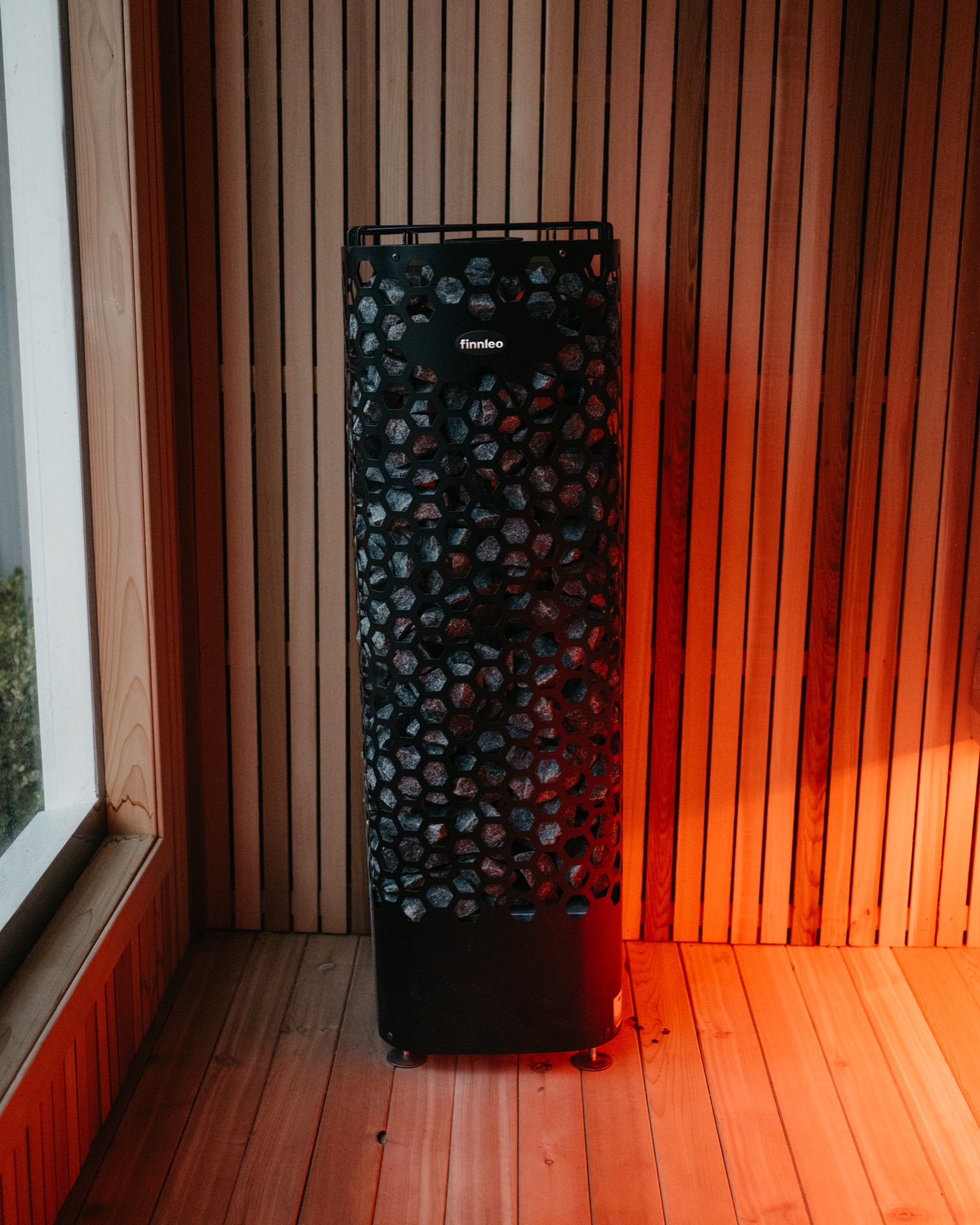
Every electric heater will get a room to temperature. What separates them is how much stone they hold, and how that stone behaves when you pour water on it.
More stone means more stored energy, a softer and more even heat, and a room that recovers quickly after a ladle instead of going flat. A heater with a token handful of rocks can hit the same number on a thermometer and feel nothing like the same room. That is why we specify heaters by stone capacity first.
The three we work with
HUUM, IKI, Harvia.
IKI is built around stone volume. The Pillar design is essentially a column of stone with the element inside it, which is why we run the IKI 9 kW Pillar as the default across our lineup. It carries about as much stone as you can reasonably put in a residential room.
HUUM pairs a substantial stone load with the cleanest industrial design of the three, and its UKU controller is the one we reach for when app control and scheduling matter.
Harvia is the volume manufacturer of the category: broad range, widely serviceable, dependable. It is the pragmatic specification when parts availability matters most.
All three are traditional electric heaters. None is infrared, which is a different appliance producing a different effect. The practice page covers why that distinction matters.
Sizing
Why nearly everything is 9 kW.
Heater output is matched to the volume of the room, not its floor area, so ceiling height counts. Our models run a 9 kW heater because that suits the volumes we build, from the two-to-four person Nook up through the 212.
Undersizing is the common mistake. A heater fighting a room never produces good heat; it runs constantly and still disappoints. The room and the heater are designed together, which is the point of building the whole envelope rather than dropping a heater into a shed.
Power
What your electrician needs to know.
A 9 kW traditional heater needs a dedicated 240V circuit run by a licensed electrician. We publish exact requirements per model during specification, so the work can be priced before you commit. The process page covers where that lands in the build.
Our heaters ship with Wi-Fi control, so the room can be brought up to temperature before you walk out to it. That sounds like a convenience feature and turns out to be the difference between a sauna you use daily and one you use on weekends.
FAQ
Heater questions.
What is the best sauna heater?
For a residential traditional sauna, the one with the most stone mass that suits your room volume. We run the IKI 9 kW Pillar across our lineup for that reason, and specify HUUM or Harvia where control preferences or serviceability point that way.
HUUM vs IKI vs Harvia, how do they differ?
IKI leads on stone volume, which is what produces soft löyly. HUUM pairs good stone mass with the strongest controller and industrial design. Harvia is the broad, dependable, widely serviceable range. All three are traditional electric heaters rather than infrared.
What size heater do I need?
Output is matched to room volume, not floor area, so ceiling height matters. Our models run 9 kW because that suits the volumes we build. We size it as part of designing the room.
What power supply does a sauna heater need?
A 9 kW traditional heater needs a dedicated 240V circuit installed by a licensed electrician. We provide the exact requirement for your model during specification.
Is infrared the same thing?
No. Infrared warms the body directly at a much lower air temperature and cannot take water, so there is no steam and no löyly. It is a different appliance producing a different effect, not a cheaper version of the same one.
Keep exploring.
Take the product quiz
Three minutes to find the right sauna and cold plunge for your space.
Browse the lineup
Hand-built saunas and cold-plunge suites across three tiers. From $26k.
The Craft
Engineered plans, sauna-grade materials, and how we build to last.
Owner stories
Real saunas and cold plunges installed in real backyards.
FAQs
Timeline, cost, permits, delivery, warranty. Straight answers.
Request a quote
Pick your model and finishes. Cole follows up within 2 business days.